
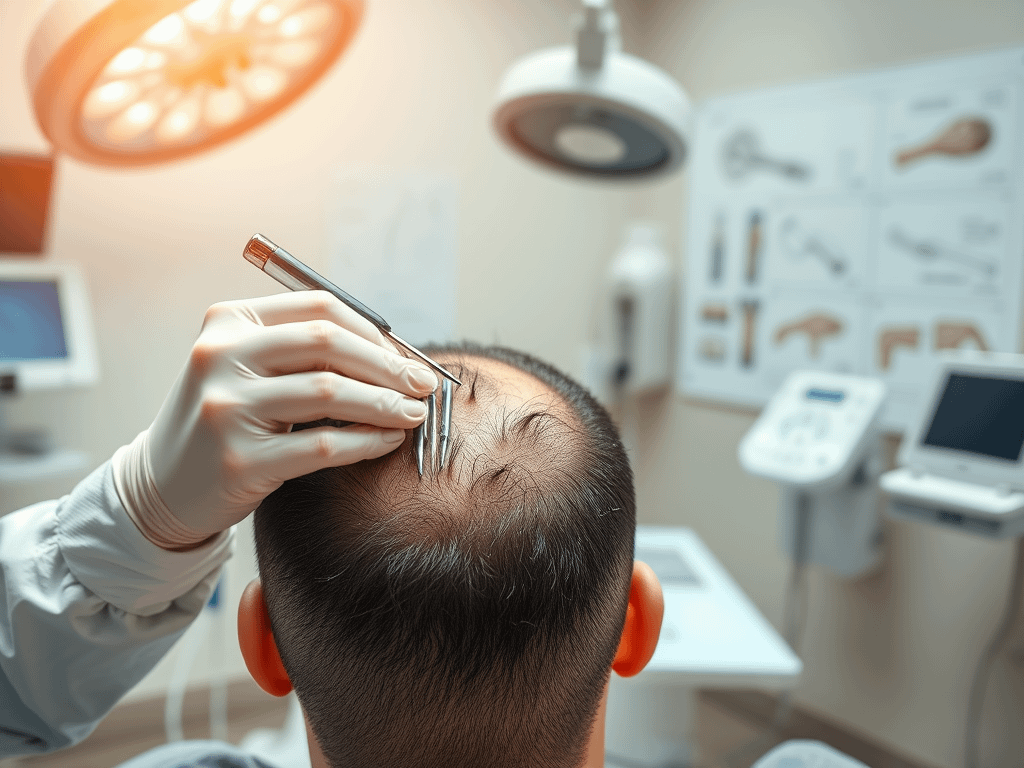
Hair transplantation is often presented as a straightforward cosmetic fix. Fly out, have a procedure, fly home with a new hairline. In reality, it is a form of minor surgery that redistributes a limited biological resource, and the outcome depends far more on planning and execution than most people realise.
This article explains how hair transplantation actually works, where problems commonly arise, and what patients should pay attention to before committing to treatment, particularly when travelling abroad.
What a hair transplant actually does
A hair transplant does not create new hair. It moves hair follicles from one part of the scalp to another. The donor area is usually the back or sides of the head, where hair tends to be more resistant to genetic hair loss. These follicles are removed and implanted into areas where hair has thinned or disappeared.
The key point is that the total amount of hair you have does not increase. Hair is redistributed. Once a follicle is removed from the donor area, it cannot be replaced. This is why donor management is central to every responsible transplant plan.
Transplanted hair generally retains the characteristics of the donor area. If it grows well there, it is likely to grow well once transplanted. If it is weak or sparse, transplantation will not magically improve it.
The donor area is the real limitation
Many patients focus almost entirely on the recipient area. The hairline, the crown, the visible bald patch. In practice, the donor area is what determines how much can be done, now and in the future.
The donor area contains a finite number of usable follicles. If too many are removed, the back or sides of the scalp can appear thin, patchy, or scarred. Overharvesting is permanent. There is no way to regenerate donor hair once it is gone.
Responsible planning looks beyond the immediate cosmetic result. It considers future hair loss, ageing, and whether the donor area will still look acceptable if further procedures are needed later. Poor planning tends to prioritise density at all costs, often to satisfy short term expectations.
Techniques and terminology
You will see a lot of terminology used to describe hair transplants. FUE, DHI, sapphire blades, micrografts, mega sessions. Most of this is marketing shorthand rather than a guarantee of quality.
FUE refers to the method used to extract follicles. It is now standard practice. DHI refers to a particular implantation tool. Sapphire refers to the material used for blades when creating incisions. These choices can influence workflow, but they do not determine the outcome on their own.
What actually matters is how gently follicles are handled, how long they are kept outside the body, how incisions are planned, and how accurately grafts are placed. These are technical and judgement based decisions. Tools do not replace skill.
Who actually performs the procedure
A hair transplant involves several distinct steps. Donor extraction, graft preparation, incision creation, and implantation. The outcome depends on how well each step is performed and on who is responsible for it.
In some settings, a doctor is directly involved throughout. In others, large parts of the procedure are delegated to technicians. This can include extraction or implantation. The level of supervision and experience varies widely.
Patients often assume that the named doctor they spoke to will perform the surgery. That is not always the case. It is reasonable to ask who does what, and whether the same people will be involved throughout the procedure. Vague answers usually indicate a system built around volume rather than individual care.
High volume surgery and its consequences
Hair transplantation is repetitive, but it is not simple. Each graft must be placed at the correct angle, direction, and depth. Small errors repeated hundreds or thousands of times become visible problems.
High volume clinics often operate on tight schedules. Multiple patients per day, rotating staff, and limited time for individual planning. This does not automatically mean poor outcomes, but it increases the risk of rushed decisions and inconsistent execution.
Production line surgery tends to prioritise speed and throughput. Hair transplantation benefits from patience and restraint. Those two things are difficult to scale.
Common problems that appear later
Many issues do not become obvious until months after the procedure. Hair growth takes time. Initial swelling and scabbing settle quickly, but the real result develops slowly.
Unnatural hairlines are a frequent complaint. These are often too straight, too dense at the front, or placed too low for the patient’s age and future hair loss pattern. Correcting a poorly designed hairline is difficult and consumes valuable donor hair.
Another issue is incorrect growth angle. Hair that grows straight up or in inconsistent directions is difficult to style and looks unnatural even when density is reasonable. Poor growth can occur if grafts are damaged during extraction or implantation, or if they are kept outside the body for too long. Donor area damage can show as patchiness or visible thinning at the back of the scalp. Some degree of shedding after a transplant is normal. This is often called shock loss. What matters is whether patients were properly informed and whether expectations were realistic from the start.
Recovery and aftercare
Recovery is not just the first few days after surgery. It extends over months. Redness, sensitivity, and uneven growth are common early on. Full results are typically assessed at twelve months or later. Aftercare is where many international patients feel unsupported. Instructions are often generic. Follow up may consist of occasional messages rather than structured clinical review. It is important to understand who you contact if something does not look right, how quickly you can expect a response, and whether further treatment is included if growth is poor. Revision surgery is not simple and is not always possible.
What to look out for before you commit
Before booking, it is reasonable to clarify who will assess your donor area, who will design the hairline, and who will perform each part of the procedure. You should know how many procedures are carried out per day and how your case fits into that schedule. You should also understand how future hair loss is considered. A plan that ignores this is unlikely to age well. Written information matters. Verbal reassurance is easy to give. Clear documentation of responsibilities and aftercare expectations is more meaningful.
When hair transplantation may not be appropriate
Hair transplantation is not suitable for everyone. People with very limited donor hair, widespread diffuse thinning, or unrealistic density expectations may not achieve a satisfactory result. Younger patients are sometimes offered aggressive hairline restoration before hair loss has stabilised. This can create long term problems if further loss occurs behind the transplanted area. Being told that you are not a good candidate is not a failure. It is often a sign of a more cautious and ethical approach.
Making an informed decision
Hair transplantation can produce good results when planned and performed carefully. It can also leave people with permanent cosmetic issues when decisions are rushed or poorly explained. Understanding how the procedure works, where the limits are, and what questions to ask puts you in a stronger position. Cost and convenience matter, but they should not override clarity and accountability.
An informed choice is rarely the fastest one. You can browse our rankings or directory to get in touch with licensed practitioners in Turkey.